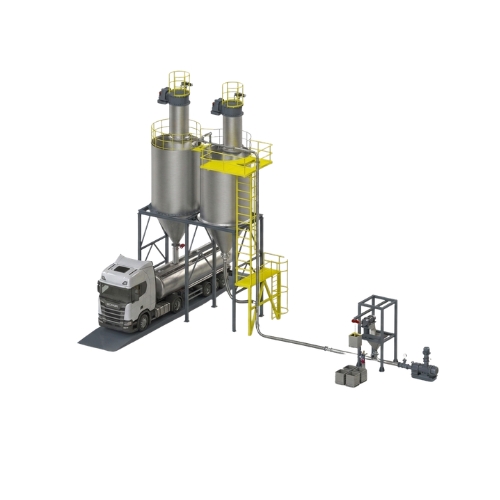
Dilute Phase Pressure Conveying System
Our Dilute Phase Pressure Conveying System is designed for the efficient and continuous transportation of powders, granules, and bulk materials using positive air pressure. Ideal for medium to long-distance conveying, the system ensures high-speed, dust-free, and reliable material handling while maintaining product quality and operational efficiency.
A Dilute Phase Pressure Conveying System is a pneumatic conveying solution that transports bulk materials through enclosed pipelines using positive air pressure at high velocity. In this method, the material remains suspended in the airflow, enabling fast and efficient transfer from one processing point to another.
Our systems are engineered to handle a wide range of free-flowing powders and granules with minimal material loss and reduced maintenance. Designed for continuous industrial operation, they provide a clean, automated, and energy-efficient alternative to conventional mechanical conveying systems.
Each system is custom-designed based on the material characteristics, conveying distance, throughput requirements, and plant layout to deliver optimum performance and long service life.
Features
- High-speed pneumatic conveying
- Positive pressure conveying technology
- Dust-free enclosed material transfer
- Continuous and reliable operation
- Suitable for medium and long conveying distances
- Low maintenance requirements
- Energy-efficient system design
- Gentle handling of free-flowing materials
- PLC & HMI-based automation available
- Custom-engineered for specific applications
Applications
- Powder conveying
- Granule conveying
- Silo loading
- Hopper feeding
- Mixer and blender feeding
- Reactor charging
- Packaging line feeding
- Bulk material transfer
- Production process automation
- Centralized material conveying
Industries Served
- Pharmaceutical
- Food Processing
- Chemical
- Plastic Processing
- Cement
- Minerals & Mining
- Paint & Coatings
- Ceramic
- Agriculture
- Fertilizer
- FMCG Manufacturing
Benefits
- Improves production efficiency
- Eliminates manual material handling
- Reduces dust emissions and product loss
- Maintains product cleanliness
- Supports continuous manufacturing
- Reduces operating and maintenance costs
- Enhances workplace safety
- Optimizes plant productivity
- Easy integration with existing systems
- Long-lasting and reliable performance
Technical Specifications
| Parameter | Specification |
|---|---|
| Conveying Method | Dilute Phase Pressure Conveying |
| Material Type | Powders, Granules, Bulk Solids |
| Conveying Medium | Positive Air Pressure |
| Conveying Capacity | Customized as per application |
| Conveying Distance | Medium to Long Distance |
| Pipeline Material | Stainless Steel / Mild Steel |
| Operation | Semi-Automatic / Fully Automatic |
| Control System | PLC HMI-Based / Controller-Based |
| Dust Control | Fully Enclosed System |
| Customization | Available as per Customer Requirements |
Why Choose Our Dilute Phase Pressure Conveying System?
Our Dilute Phase Pressure Conveying Systems are engineered for reliable, high-performance material handling across a wide range of industries. Built with premium-quality components and advanced pneumatic conveying technology, each system is customized to match your process requirements, ensuring efficient material transfer, reduced downtime, and long-term operational reliability.
Frequently Asked Questions
What is a Dilute Phase Pressure Conveying System?
A Dilute Phase Pressure Conveying System transports powders and granules through enclosed pipelines using positive air pressure, keeping the material suspended in a high-velocity airflow.
Which materials can be conveyed?
The system is suitable for free-flowing powders, granules, pellets, and other bulk solids used in industrial processing.
Can the system be customized?
Yes. Every system is designed according to your material properties, conveying distance, required capacity, and plant layout.
What are the advantages of dilute phase pressure conveying?
It offers high conveying speed, dust-free operation, reduced manual handling, low maintenance, and efficient material transfer over medium to long distances while supporting automated production processes.